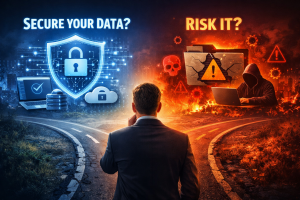
The psychology behind protection, risk, and “it won’t happen to me”
Walk into any room of business owners and ask a simple question:
“How important is protecting your business data?”
Every hand goes up.
Now ask:
“Who is confident they could prove they were properly managing it if something went wrong?”
Far fewer hands stay up.
That gap…
That’s not a technology problem.
That’s a psychology problem.
The Illusion of “It Won’t Happen to Me”
Most business owners don’t consciously choose to ignore security.
What actually happens is far more human.
We’re wired to assess risk based on experience, not probability.
- If they’ve never had a breach → it feels unlikely
- If nothing has gone wrong so far → it must be working
- If they hear about attacks → it’s always “someone bigger”
This is known as normalcy bias.
It’s the same reason people ignore fire alarms, delay insurance, or put off writing a will.
Until something happens, it doesn’t feel real.
Compliance Becomes the Finish Line (When It Should Be the Starting Point)
Then there’s legislation.
Things like GDPR, Cyber Essentials, ISO standards.
These are meant to raise the baseline.
But psychologically, they often become:
“What’s the minimum we need to do to be compliant?”
Instead of:
“What do we actually need to protect the business?”
This creates a dangerous mindset:
- “We passed Cyber Essentials, so we’re fine”
- “We’ve got policies, so we’re covered”
- “We ticked the GDPR box”
But here’s the reality:
Legislation is always behind the threat.
It has to be.
Law moves slowly.
Technology evolves rapidly.
Attackers adapt instantly.
So if your strategy is based purely on compliance…
You are, by definition, behind.
The Cost vs Value Trap
Another psychological barrier is how security is perceived commercially.
Security is often seen as:
- A cost
- A grudge purchase
- Something that doesn’t generate revenue
And because it doesn’t produce visible output, it’s easy to question:
“What are we actually getting for this?”
Compare that to marketing or sales:
- Clear ROI
- Visible activity
- Tangible outcomes
So security gets deprioritised.
Not because it’s unimportant…
But because it’s invisible when it’s working.
The “We Trust Our People” Fallacy
Many breaches don’t come from hackers.
They come from:
- Sending an email to the wrong person
- Clicking the wrong link
- Using a weak password
- Losing a device
Yet business owners often say:
“We trust our team.”
And they should.
But trust is not a control.
Good people still make mistakes.
The psychology here is simple:
- We associate risk with malicious intent
- We underestimate risk from human error
That’s where most GDPR breaches actually come from.
Accountability Changes Behaviour
Here’s where things shift.
When a business owner realises:
- They could lose access to systems
- They could lose client data
- They could lose revenue overnight
- They may need to explain themselves to regulators, insurers, or clients
The mindset changes from:
“What do we need to do?”
To:
“Can we prove we were managing this properly?”
That’s a completely different question.
And it drives completely different behaviour.
Common Sense vs Compliance
The most resilient businesses don’t stop at compliance.
They apply common sense thinking:
- “What would actually hurt us if it went wrong?”
- “How would we operate if we lost access tomorrow?”
- “What would a client expect us to have in place?”
They build controls around real-world impact, not just regulatory checklists.
Because deep down, they understand:
You’re not judged by whether something went wrong.
You’re judged by whether you were managing it.
Why Some Act… and Others Don’t
So when you strip it back, the difference isn’t technical.
It’s psychological.
Businesses that take security seriously tend to have:
- A stronger sense of accountability
- A clearer understanding of risk impact
- Experience (either direct or indirect) of things going wrong
- A leadership mindset focused on protection, not just growth
Those that don’t are often:
- Relying on luck (without realising it)
- Anchored to “nothing has happened yet”
- Focused on cost over consequence
- Mistaking compliance for protection
The Reality
Every business is one mistake away from:
- A data breach
- A payment being redirected
- Losing access to systems
- Reputational damage
Not because they’re careless.
But because modern business relies on technology that is constantly under pressure.
Final Thought
Security isn’t really about IT.
It’s about how you think about risk as a business owner.
Do you:
- Do the minimum required…
- Or manage it as a core part of running the business?
Because when something goes wrong—and at some point, something will—
That decision is what defines the outcome.